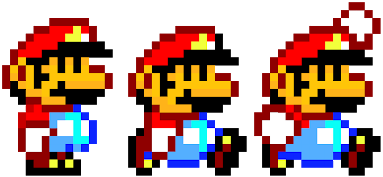
“You only enjoyed it because you were a kid.”
Trying to eliminate personal bias when talking about something you love is difficult, and talking about video games is nothing different. There are many aspects to games that deserve attention when criticizing them—graphics, controls, stories, themes, etc.
As the gaming industry developed, so did these games in terms of performance and storytelling, wherein previous technological limitations have been surpassed by developers.
These technological feats can occasionally be seen in franchises spanning over different generations of video game platforms, wherein there is a direct comparison between the first and last in the franchise, having drastic differences in graphics and performance.

Legend of Zelda (1986) ©Nintendo® 
Legend of Zelda: Breath of the Wild (2017) ©Nintendo®
At this point, I seem to sound like I am making the case that newer games are better than older ones, which I cannot doubt is the case a lot of the times, with developers every year outdoing themselves trying to find optimal ways for players to enjoy their games, all the while improving upon the quality of aesthetic in graphics and design.
However, many within the gaming community continue to praise the preceding titles of the older generations of video games, claiming value in their quality as pieces of antiques in the development of video games. Some might even go as far as to attack the newer titles of long-running franchises, claiming that the newer ones have “ruined” the essence of the franchise.
It sounds as if many of these are people attached to memories of the past, and, as a result, led to many counter-arguments that these people have “mere nostalgia” over past games. But is all this, the games that many, including myself, continue to talk about till this day, just nostalgia?

Design Difference
The nostalgia argument can also be countered with this simple statement—they are different. By this, what it means is that it is not fair to simply compare modern games to retro games by their technological differences, as many past games are completely different in design and mechanics from games now.
As an example, Metroid 1986 and Metroid Prime are of the same series but are completely different games in terms of design and mechanics, wherein Metroid Prime is a first-person shooter game that is much more grounded and gritty with its alien aesthetic to match its much more complex mechanical gameplay, while Metroid 1986 is a platformer game with much more colorful and vibrant visuals to contrast its simple design.
Whichever of these games is better is up to you, but it is never fair to compare these two and say that one is superior over the other and to argue that liking the older entry of a series as simply having nostalgia over the past and not having its own merits to be admired and valued within the gaming community is simply close-minded.

Metroid Prime (2002) ©Nintendo® 
Metroid (1986) ©Nintendo®
Your First Time
There is an idea that your first experience in a video game genre will be your most impactful. Try and ask any player their all-time favorite MMORPG, and it’s probably their first one—it maybe even be something they’ve sunk thousands of hours in playing, more than any other game they’ve played. This can apply to video game series, as well.
People growing up with the classic titles of the Legend of Zelda and Super Mario Series tend to be much more attached to those rather than the most recent ones. For example, many Zelda fans point to Legend of Zelda: Ocarina of Time as an example of an older title in the series that remains their most valued and most influential in the Legend of Zelda series.
In terms of technicality, yes, Ocarina of Time is a revolutionary title in the video game industry, not just the series, as it was one of the first to have a bright, new 3-D world, having a seemingly endless landscape to explore in the game. But with arguably dated controls and mechanics, it doesn’t hold a candle to the sleek performance and astounding graphics of the newer titles such as Breath of the Wild.

If that’s the case, then why do some people tend to appreciate older, outdated games over newer, modern games that are arguably better in technical and aesthetic aspects? Well, I believe it has something to do with how games have evolved over time, not just its technicalities.
Over time, with companies and producers making a profit out of making video games, game developers and designers have opted to create more mass appeal to players. They’ve done so by toning down the difficulty in video games, having much more simpler mechanics that general audiences can easily pick up on the spot. This has also led to designing games that are much more cinematic in its aesthetic, dedicating a lot of time in storytelling through cutscenes, sacrificing a lot of gameplay in the process.
A popular joke within the gaming community is the “press X to do something”, wherein the now popular video game mechanic of pressing one button to do a very elaborate action or movement is ridiculed over its simplicity and laziness in design—this is an example of both lowering difficulty for general audiences and sacrificing gameplay for cinematography, which many claims to plague the video game industry today.

God of War (2005) ©Sony® 
Ninja Blade (2009) ©From Software®
With that said, I believe that older games have a very distinct feel that differs from the modern games we are so familiar with now. Because they were made in a time when the limits of technology hindered them from being spectacular feats of aesthetics with hyperrealistic graphical fidelity and film-like cinematography, they were made with the intent of simply being games that are fun to play. They are certainly not perfect, and newer games have definitely solved the flaws these older games have, but these games are as they were supposed to be—something fun to play.
“Above all, video games are meant to be just one thing: fun. Fun for everyone.”
Satoru Iwata, 4th President and Chief Executive Officer of Nintendo®

